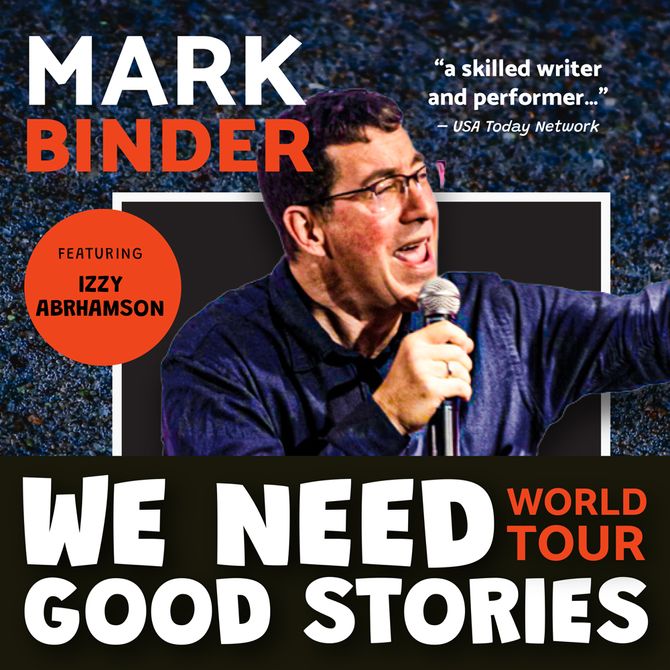
It’s 2010, which to me seems like a date far far in the future. The world that I grew up in has changed radically, and I can’t pretend I didn’t see it coming.

- Chevy isn’t Chevy. It’s Chevrolet. No, it’s Chevy. And none of us really care, do we?
- BP (and every other major oil company in the world) seems to have pretended that an offshore oil leak was impossible, and made absolutely no plans to fix one. Clueless? Yep.
- And if there’s one constant in our lives, it’s Constant Contact. You and I are bombarded with these canned missives from friends, businesses, non-profits, radio stations, and President Obama.

Which brings me to my week.

As you may know, I’ve got two new story/comedy/spoken words albums being released this year: “A Holiday Present!” and “It Was A Dark and Stormy Night…” My record company and I are hoping that they do the iTunes equivalent of going platinum… but how? And then what?

According to some internet wonk, every “fan” is worth $150. I’m not sure I buy it, but maybe all those new fans will be big spenders… Maybe I’ll get picked up by LiveNation and end up on Dancing with the Stars. (Or maybe a new reality show, “Lying with the Politicians!”)

Anyway, we’ve been looking at how to keep in touch with the millions (fingers crossed) of new fans to come. So, I spent five business days evaluating different email distribution platforms. Constant Contact, Awebber, iContact, Mailchimp, ezinedirector, jangomail…  Why? So that I can count clicks and clickthrus, so that I can track who opens my emails and who ignores them. So I can set “campaigns” and create new marketing strategies…

Truth is I hate ‘em all. Can’t stand them. Too much time required to set them up, too much information given to an anonymous company, and paying for email rubs against my grain.

And the more time I spend on that, the less time I actually spend on writing and telling stories — which is my job.

My conclusion — after much time and internal agony — Keep things the same!
Yes, it is possible, even in the post-post-post-post modern era to maintain the status quo — and save money doing it.

Welcome to the new BarkMinder, same as the old BarkMinder…
In the future, we’ll try to keep the upbeat stories high, the rants to a low, and provide what we used to call, “good stories,” but have now Chevroletized to call, “High Quality Content.”

As always, it will be random, haphazard, and I hope fun for you and your family.

That said, I’ve started to upgrade my electronic distribution methodology, and I thought I’d give you the details.
Tell your friends, join fan pages…

By the way…
Here’s a SUPER Secret…
Next week, I’m told that I’ll be giving away free copies of one of my albums to all my fan club members.
So have folks sign up

Enjoy the day.
- Mark

The electronic distribution segment!

Fan Club Signup: http://www.markbinder.com/lists/

Facebook Fan Page: http://bit.ly/mark_facebook
Twitter Account: barkminder
Weblog: http://www.barkminder.com/
Myspace: http://www.myspace.com/markbinder

Why Tell Stories?

What makes one person effective and another powerless?

The key difference is in the stories that these people tell. The mover and shaker says, “Money can buy change.” He either has the money to start with, or he finds it. The powerless say, “I don’t have enough money to buy change.” Or even worse, “I’ll never have enough money to buy change.”

One story empowers, the other story cripples. One cre- ates opportunity; the second paralyzes.

The sad truth is that many people believe their own crippling stories. They don’t understand that these narra- tives that they tell themselves and others are just “stories.” They believe them to be “truth.” There is often evidence to “prove” the story is true.
Which is more true?

  • “They’ll never listen. They’re stupid. They’re lazy.”
  • “They don’t understand. They don’t know. I’ll help.”

Notice the existing stories.

Are you stuck in a story? What are the stories you tell about the world, your business, your organization, your city, your community, your family, yourself? Are these stories useful, inspiring and productive? Do they get to the heart of what your organization is about and what it means to create?

Now take a moment and make up a new, alterna- tive story. One you’d like better. It doesn’t matter if it’s “true”—you will make it true. Reshape the story. Invent a happier ending. A breakthrough improvement. An incre- mental, but sustainable change…

Are these optimistic stories any less possible than the pessimistic ones? What is the difference between a com- munity that says, “It’s terrible, the pollution, the sprawl. Everything is out of control.” and a community that says, “We are doing whatever it takes to make our world safe and give our children better futures.”

<To be Continued>

This is part of an ongoing series of articles based on my “Crafting Stories to Change the World” workshop for businesses, non-profits, and individuals interested in making a difference. More information at http://www.markbinder.com/business/

Here in Rhode Island, we seem to have a tradition of corrupt politicians. From our dumpster-diving Governor Ed DiPrete to Providence’s convicted mayor-turned-talk-show-host Vincent A. “Buddy” Cianci, the antics of elected officials fill the news, and fill us with a mixture of disgust and delight.

I mean, really, what could be better than the image of a pudgy balding man digging through the dumpster behind Walt’s Roast Beef on Airport Road looking for a brown paper bag filled with a $10,000 payoff?

Or my favorite from Buddy’s first term: the mayor ordering his Providence Police Officer bodyguard and chauffeur to hold down his ex-wife’s lover whom he then threatened with a burning log.

If it was Hollywood, you’d say it’s fiction, but here, it’s just another day.

Recently, we’ve been having a spate of new accusations. I’ll just give the brief updates, and try to keep you posted as things get more heated.

  • In Central Falls, a one-square mile city that was once wealthy, but is now the poorest spot in the state, the Mayor has been accused of giving city contracts for a friend to board up abandoned buildings in exchange for “considerations”
  • In East Providence, three city councilmen were just indicted on corruption. It seems that they split a payoff to approve a zoning variance for a large shopping plaza. They didn’t know that the other counselor had spoken to the FBI and was wearing a wire… Of course it still meant that the zoning was approved…

Anyway, I thought you’d enjoy hearing a bit about our peccadilloes. More as they develop…

And to celebrate, my comic story, “Old Scratch Nickels” was just posted up on iTunes!
Download it, listen and laugh! http://bit.ly/oldscratch

Please be patient while I restart….

A little blogging history, while we rebuild…

In 1997 I began writing a week weblog called, “Grinning into the Millenium.” At its peak, there were about 1,200 subscribers to this early blog. Of course in 2000, the column became irrelevant, so I stopped.

Then came Blog 2.0.  I hadn’t done much with it. Just a few posts here and there.

Welcome to Blog 3.0! New, improved!

I hope you enjoy it.

This is a reprint of a blog essay/talk that I first gave in 2007. It has proved to be a few years ahead of its time…

I love books. I love that they are what they are. Pages. Words. Paper. Ink. Books are a thing in a way that CDs are things. They can be looked at and handled. They have texture and color, and they don’t vanish when the power goes out.

Recently, as I was cleaning out my office, I found a thesaurus and the old Quality Paperback Club version of the Columbia Encyclopedia. Neither of these have been touched in years, because it’s so much easier to just use the keyboard.

But I remember when you could extrapolate enough facts from a brief section of the Columbia Encyclopedia to flesh out a character. Or the random flip of a Thesaurus page would inspire a different direction in a sentence.

Now everything is digital. This email is something you’re reading in a swamp of other bits and bytes on the screen. You might still subscribe to a newspaper, or you might just check the paper’s website. Or not even bother with that. Perhaps you’ve got a list of blogs you check.

We’re all checking and writing and copying and communicating, but the thingness of things is going missing. The tangibility. The feeling offline.

On the one hand, thank goodness for coffee shops, because they bring us together (each with our own laptops) so we at least see other people. On the other hand, do they all have to be a generic multinational conglomerate coffee shop? It’s still a thing, but it’s the same thing — which is comforting, but at the same time…

What about the local thingness of things. This is the biggest hole that the vanishing newspaper leaves. Yes, there are any number of local websites and blogs, but the universality and thingness of the newspaper creates a community. And that’s going the way of the dodo and the slide rule and the compact disc.

Sigh. Sometimes I think I’m an old fuddy duddy luddite. Kids, you see, won’t notice these things. They’ve never heard of rotary dial phones either. Many of them may never have a “land line.” They live untethered.

So, I’ve been doing a lot of thinking about the value of books asthings. Things to look at and touch — not just access or data mine.Things to spend time with and absorb, not just scan. Permanentthings. Annoying things. Things that pile up. Things that are made by people.

On the one hand, if I never buy another cd, I’ll probably be a little sad, but I won’t really miss them too much. Too much plastic. On the other hand, I’m going to miss the feel of newsprint every morning when my latest newspaper is “downloaded” onto my ipodpaper.

But mostly I’m going to miss the fact that the newspaper will always and only be the newspaper. That the book — that book right there — will always and only be that book. It won’t be gone one moment replaced by the next bit of data.